The organising committee for ABNMS 2015 is pleased to invite the submission of abstracts.
Abstracts are invited from all fields. Past presentations have covered a wide range of disciplines including environmental management, geology, law, ecology and medicine, and a variety of technical aspects on methods of development, data mining, linking GIS with Bayesian Networks, and lessons learned from particular BN projects.
Those beginning to use Bayesian networks are invited to present prospective projects for discussion.
Key Dates
Call for abstracts: 31 July 2015
Abstract submission deadline: 4 September 2015
Decision on abstracts: 11 September 2015
Deadline for conference registration (including pre-conference tutorials): 21 September 2015
Include the title of your presentation, authors, affiliations, contact details for the corresponding author and abstract. The abstract should be self-contained and explicit, covering the aims, methods, results and main conclusions of the work. The abstract should not contain figures, tables or references.
Travel Grants
The Australasian Bayesian Network Modelling Society (ABNMS) is offering 4 travel grants to attend the ABNMS Tutorials and Conference 23-26 November 2015 Melbourne, Australia. Awards will be for $250 to $500 to contribute to the costs of travel to and from the conference.
Three Student Grants will be awarded and one 2015 Travel Grant for any person who attended the ABNMS pre-conference tutorials in 2014 in Rotorua, New Zealand and will present in 2015.
Applications should include a brief statement indicating the type of travel grant being applied for, justifying the application, an estimate of travel costs, a scanned signed statement from an academic supervisor verifying student status (if in application for one of the student travel grants), and a CV. An abstract of the talk to be presented at the conference must be submitted in parallel (see above). Student travel grants will only be awarded if the recipient registers for the conference and tutorials. Please note the 2015 Travel Grant recipient is not required to register for the pre-conference tutorials.
Travel grant applications must be submitted by email to president@abnms.org by 20 September 2014.
If you have any questions regarding ABNMS2015, please email ABNMS2015@abnms.org.
We are pleased to announce that we will be holding our Introduction to BNs workshop in Melbourne on June 18-19th at Monash University's Caulfield campus. This is an excellent opportunity to learn the foundations of Bayesian networks, common extensions and connect with others in using the techniques.
If you would like to attend, please register at the following site:
http://bayesian-intelligence.com/training/
There you will also find a draft workshop schedule with an overview of the topics covered. If you are unable to make these dates, please email me indicating your interest in attending at another time.
For more general information about our workshops, you can visit http://bayesian-intelligence.com/training/ where you will find contact info.
Finally, please also feel free to pass this email on to anyone you know that may be interested in attending our BN training courses.
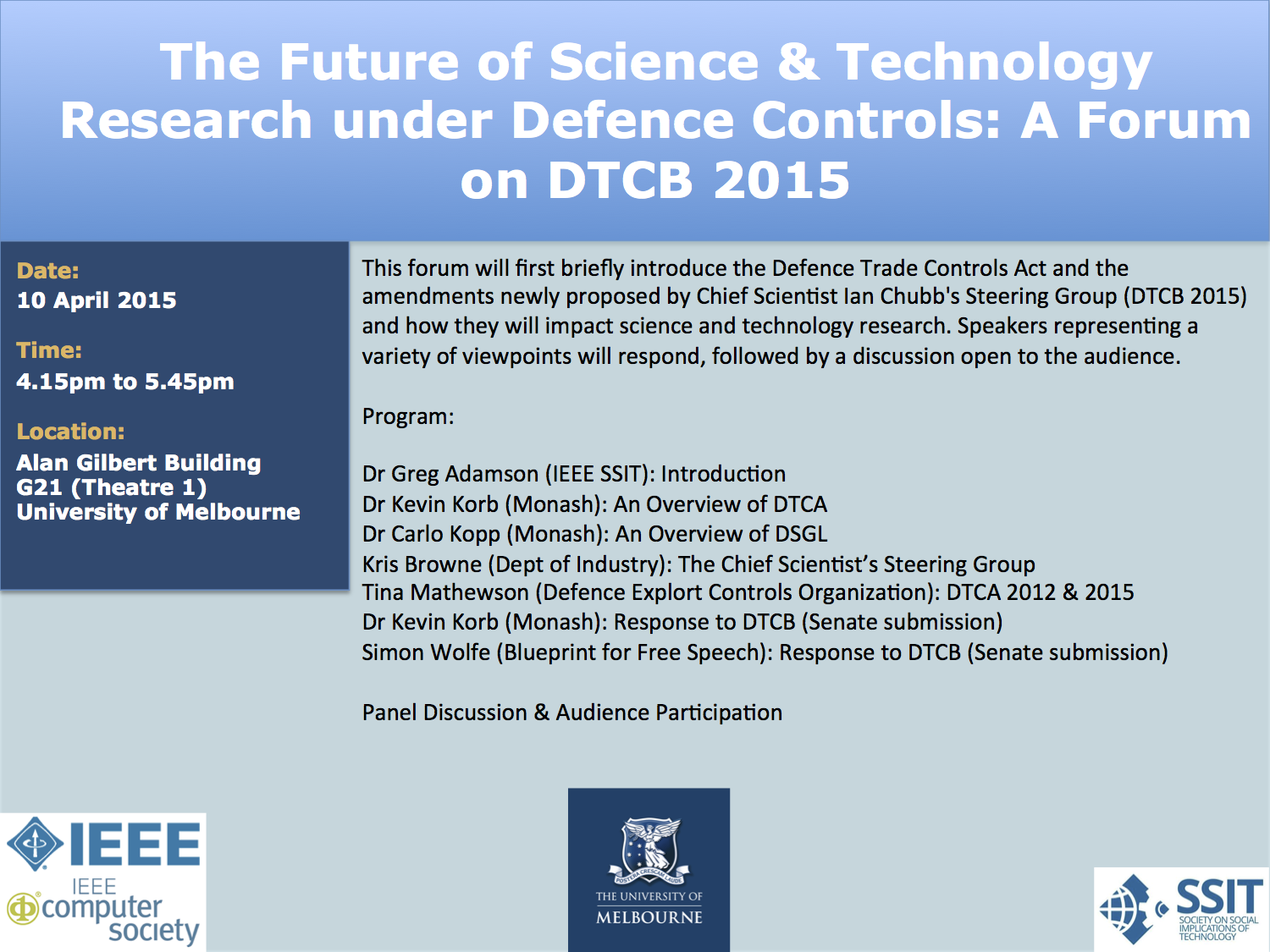
The DTCA (Defence Trade Controls Act) Forum we held on 10 April at the University of Melbourne on Defence regulation of science and technology in Australia was recorded. Here are the available video links:
The forum included the following two talks which give an overview of the DTCA legislation and its potential impact on Australian science and technology:
Due to demand, we are pleased to announce that we will be holding two two-day Introduction to BNs workshops in February: in Melbourne on February 12-13th, and in Townsville on February 26-27th. This is an excellent opportunity to learn the foundations of Bayesian networks, common extensions and network with others in using the techniques.
If you would like to attend either of the sessions, please register at the following site:
There you will also find a draft workshop schedule with an overview of the topics covered. If you are unable to make these dates, please email indicating your interest in attending at another time.
In passing the Defence Trade Controls Act 2012 the Australian parliament responded to concerns that the Act would impose too great a burden on scientific and technological research in Australia by deferring its enforcement for two years and setting up a Steering Group to review and propose amendments in the meantime. That time is up, and the Steering Group has issued its proposed amendments. Below is my submission to the public review of the amendment, which is finishing at then end of January, that is, the end of this week.
Submission in Response to the Defence Trade Controls Amendments Bill 2015 (DTCB)
The DTCB seeks to rectify some of the errors introduced with the passage of the Defence Trade Controls Act 2012 (DTCA). It goes about this by ameliorating some of the burden imposed on institutions and individuals created by DTCA in doing research on dual-use (not military) goods. In my view, the DTCB is misdirected and likely to fail to afford sufficient relief for many researchers and research projects, leading to tertiary education and research paying a very high cost for little or no benefit in the near to medium term. The correct remedy would be to rewrite the DTCA so as to include provisions closely comparable to the corresponding UK and US legislation that exempt publication, scientific research and higher education involving dual-use goods. For example, the UK Export Controls Act 2002 (section 8) explicitly exempts:
the communication of information in the ordinary course of scientific research; the making of information generally available to the public; or the communication of information that is generally available to the public
while nevertheless allowing a Ministerial override in exceptional cases. The DTCA contains no protection for ordinary scientific research and education. The Steering Group's proposal is meant to address some of the defects thereby introduced, but clearly the most direct and effective addressing of the defects would be to write a comparable clause into the act rather than try to treat all of the symptoms of illness that the lack of the clause must necessarily introduce. By the latter approach the illness will remain and any failure to see or predict a nasty symptom will only be treated retrospectively, after the damage has been done.
The Chief Scientist's Steering Group claims that part of its mandate is to see that researchers are not disadvantaged in comparison with the United States and the UK. That is an objective that simply cannot be met without adopting equivalent legislation.
Having registered my general objection to the approach of the Steering Group, I will review some of its specific proposals.
The greatest attempt at relief of the DTCB 2015 appears to be the exemption for publication and pre-publication of dual-use goods, distinguishing these from the international "supply" of goods. This will indeed enable some research to progress across many areas which otherwise, under DTCA 2012, would be impossible. It appears that the Steering Group considers this to be relief enough, but massive problems remain. In particular, electronic and other transmissions of new research in dual-use goods which are not directly related to publication or an attempt to publish would remain controlled, and unpermitted communications punishable by prison, even though these are a part of the ordinary course of scientific research. A great deal of existing friendly communications with international research collaborators, potential collaborators, students, etc. will be criminalized. Also included as "supply" are ordinary scientific conferences and meetings, if they neglect to publish proceedings. Invitations to visit and give talks at leading institutions around the world will have to routinely be turned down by researchers in controlled areas, unless they take the opportunity to never return to Australia. [It should be noted that there is a specific exemption for exclusively oral communications; however, it is typical that pdf notes are projected on host equipment, which would be a criminal act of "supply" under the legislation.]
Since our institutions are pushing hard to internationalize our research collaborations and educational activities, the treatment of them as criminal actions when outside the direct control of the Department of Defence will seriously handicap both research and education in dual-use areas. Educational institutions will no longer be able to treat their materials as proprietary and instead be forced to publish them. Pre-publication collaborative research, on the other hand, is always an iffy project, and publications, or even attempted publications, are no sure outcome. If the activities needed to generate good research are controlled, it will not much matter that its end product (publication) is uncontrolled: there won't be anything to publish.
The option to emigrate, if taken, will have to be taken permanently, by the way, without any opportunity to return to visit friends or family, unless the academic is willing to face arrest for the "crime" of having pursued her or his career overseas. Indeed, it would be conceivable that Australia should seek extradition of such notorious criminal academics. It's also clear that proprietary dual-use industrial research, which is hardly ever published, must come under the control and permit regime, meaning that the Steering Group's amendments offer industry no relief at all.
The Steering Group's Guide claims that the Defence and Strategic Goods List (DSGL) is narrowly defined so as to minimize its impact on civilian research. As an example, they point out that restrictions on research on robust computers designed to deal with temperature extremes are limited to those that fall outside the wide bounds of -45C to 85C. But the DSGL in this respect suffers from the same kind of flaws as the approach taken by the Steering Group: it excludes from its onerous restrictions research which its drafters happen to know and think about, but capturing a great deal of potential civilian research that hasn't occurred to them. For an example: fault-tolerant computing is a general concept of wide civilian applicability. It is covered as dual-use in DSGL, but with exclusions of the above type. For a particular example, error detection and correction in "main storage" is excluded from the DSGL restrictions. However, it apparently did not occur to the drafters that many computers have error detection and correction outside of main storage, in particular in components involved in internal and external communications. As the DSGL currently stands, research on such fault-tolerant aspects of computing is regulated, even if that research is effectively the same as research done to improve "main memories".
When I scanned my faculty's (Monash Faculty of IT) postgraduate classes, I found about one-third them touched upon or directly treated research areas covered by DSGL's dual-use list. The DSGL is emphatically not a narrow list impinging upon only a few exotic research areas.
To be sure, the exact scope of the DSGL is unclear. A key example (for me, at any rate) is robotics: robots are explicitly controlled as a dual-use good (at least when coupled with the usual image processing). Since software connected with a controlled dual-use good is automatically controlled, and since any artificial intelligence software may be used in robots with image processing, the DSGL seems to imply that all AI research is controlled. I have, many months ago, asked DECO whether this is correct; I have received no answer. On the face of it, however, DTCA and DTCB are set to eliminate Australia as a serious player in information technology.
Under both the existing and the proposed legislation coverage of the DSGL is subject to the interpretation of the Department of Defence. Since the DSGL is both ambiguous and has an overly broad coverage of dual-use goods, as argued above, the proposed legislation will inevitably provide the Department of Defence the power to choose to enforce, or to not enforce, penalties against researchers whose projects may be interpreted as falling under DSGL controls. This will inevitably result in discouraging research in any such area and will also provide the Department of Defence apparently arbitrary powers to persecute or punish civilian researchers at will or whim.
The reassurance that the Criminal Code Act 1995 would make unlikely a successful prosecution of those who "diligently" follow compliance rules but make some mistake is very little comfort: 1) although the proposed amendments reduce the compliance costs of DTCA 2012, those costs remain very high; 2) the latitude in interpreting DSGL means that an innocent mistake may well be interpreted as an intentional violation of the law; 3) prosecutors in all legal systems around the world have on at least some occasions abused their power and prosecuted people, not to enforce the law, but for political or private purposes that may be served regardless of the outcome of the prosecution.
The Steering Group refers to the DSGL exemption for "basic scientific research" and information that is already in the "public domain", suggesting that in such cases research communications will thereby not be subject to control by the Department of Defence. The DSGL does make these exemptions and also one for patent applications. Neither the UK nor the US found those exemptions to be adequate and expanded the scope of exemptions in their further legislation, as I showed at the beginning. In my view, they have good reasons not to rely upon the DSGL alone. The Steering Group omitted mention that the DSGL restricts the exemption for basic scientific research to research which is not also intended for application. However, the ARC, universities and other funding organizations almost always demand that research be conducted with a view to its application, suggesting that the DSGL exemption will hardly ever come into force. It has also been pointed out that the administrative burden of determining what is and what is not in the public domain across hundreds of research areas by both research organizations seeking to be compliant and by the Department of Defence itself in monitoring compliance will be enormous.
In conclusion:
There is no doubt that some new legislation is needed to deal with "intangible supply" of military technology. It is also appears right that dual-use goods should come under the control of such legislation, since by definition they may be used in military applications. But nowhere has a serious case been made that the same protections for education and academic research that the UK and the US afford themselves should not be made available to Australians and Australian institutions. Without those protections not only will civilian research in dual-use goods suffer from onerous compliance costs, those research and educational areas will inevitably go into significant decline, damaging the wider economy for at least as long as it takes the society as a whole to come to grips with the issue and change the law appropriately. And there will be no guarantee that the damage that accrues in the meantime can be undone.
The proposed amendment alleviates a few of the problems introduced by DTCA 2012. It manifestly fails in its stated goal of putting Australia on an equal footing with its trading partners, the US and the UK. This failure will cause serious and long-lasting damage to Australian education and research, unless it is addressed now.
I think Australia's Chief Scientist does not deserve an F for his efforts. He should, however, be encouraged to try a little harder and apparently needs more time to do so.
The Australian government is undermining the future of Australia by attacking science and technology research and education on a massive scale, leading Australia in a unique act of self-immolation. It is not hard to see that the future economic well-being of developed countries is intimately linked to the three key supports of modern economies: science, technology and education. This government is actively attacking all three and is also actively campaigning against all three in the media, especially through its cheerleaders in the Murdoch press.
These are some of the notable attacks on science, technology and education enacted, proposed or supported by the ministers of the Abbott government:
Attacking the Internet in Australia by cutting the fibre-optic based National Broadband Network project started by the Labor government. Instead of fibre optics, Minister for Communications Malcolm Turnbull advocates the retention of slower, older and more maintenance-intensive copper wire connections to homes and businesses. As iinet likes to advertise, Australia is behind Romania in average Internet access speeds. Turnbull's program will keep Australia well behind the OECD average for the foreseeable future. Neither Turnbull nor Abbott have a clue that the Internet has become a key enabler of current economic growth. Watch this incredible performance by the pair of them, laughing about the Internet being a "video entertainment system". Or, watch Turnbull in this whiteboard "explainer" on how the value of the NBN in 2030 should be assessed based on the values of 2014. These are the current leaders of our government!
Cutting science research, in particular the government is cutting funding to the Australian Research Council by around $29M per year (about 5%), to CSIRO by $86M (about 6%), to DSTO by $48M (about 10%), and to the Cooperative Research Centre program by $25M (about 14%). There are hints that more cuts are to come. These programs have been the source of much of the innovation in Australia, so their winding down will kill off what was already a weak contributor to the economy.
Cutting university and school funding. $30 billion has been cut from school funding, by dropping the "Gonski" reforms that Abbott previously committed to implementing. University funding per student is being cut 20%. As the OECD's Education at a Glance documents year in and year out, public education is central to economic well being; these cuts will lead Australia to the bottom of the OECD not just in education but also in future economic performance.
Many university administrators have been gulled into supporting this by the lure of the deregulation of university fees. While it may be possible for universities to make up the funding cuts by raising fees to students, it is hardly obvious that it will happen, since many students may turn away from accepting life-burdening debts in return for an education. In any case, this will increase inequality of access to education and undermine education's role in driving future economic prosperity.
The law was amended in a minor way in 2012 to enable a "Steering Group" led by Chief Scientist Ian Chubb to review and make recommendations for changes over a two-year period. That is why the legislation is only coming into force in May, 2015. Chubb appears to be a useful idiot for the government: his enlarged opinion of his own ability to effect changes to the law has been widely accepted within academia, with the result that many or most academic leaders have reacted with supreme complacency to the DTCA. As the drop-dead day comes nearer, we can expect more and more academics to realize that they are being turned into criminals. The NTEU has recently launched an educational campaign to inform an academic community that is still mostly asleep.
Cutting funding for the ABC and SBS. The ABC has been stripped of the Australia Network, which has been handed over to Sky News Australia, partly owned by Murdoch. This is despite the fact that the Australia Network has been a very well received broadcaster to our near neighbors for decades, providing valuable good will for our diplomatic and trading interests. Furthermore, after heavy campaigning by the Murdoch press, both public broadcasters are having their funding cut, with threats continuing of larger cuts in the future. Turnbull claims "efficiency savings" are always possible. Were that true, budgets could always be cut to zero, matching his apparent IQ.
The dramatic budget cuts are explained by Joe Hockey and Tony Abbott as being "necessary" to save Australia from a budget crisis inherited from the Labor government, as well as being dictated by fairness in spreading the burden of this salvation across the community. Although many economists have publicly denounced the claim of Australia being in budgetary crisis as nonsense, it is no surprise that the Australian public have largely seemed to swallow it whole. The Big Lie worked very well for the Nazis, and it is working very well for the Coalition government. After all, the Murdoch press controls most of the print news in Australia and very clearly sets the direction of public debate. Big Lies repeated over and over begin to seem like common knowledge rather than common nonsense.
Abbott claims his government needs no minister for science. He claims to be able to represent the portfolio unassisted. However, his understanding and interests are inimical to science, technology and education and to the long-term interests of Australia. He infamously denounced the scientific consensus on global warming as "absolute crap". He seems to view science as a convenient source of opinions, when scientists happen to agree with him, and otherwise as a nuisance. The long history of science supplying the ideas and means for engineering and technological development from the beginning of western civilization means nothing to him; instead, Abbott and his ministers prefer to attribute that history of civilization to Christianity. Theirs is a view that would have been well received in the Dark Ages.
If anyone is going to lead Australia into a new Dark Age, it is Abbott and his government: the terrorism of ISIS is nothing compared to the terrorism of our own government.
We will be meeting in Rotorua, New Zealand, 26-27 November and welcome abstracts from anyone in the Bayesian network community, whether in applied sciences, government, industry or academic research. See
Note that our conference is preceded by a two-day tutorial program covering Bayesian networks, including introduction, elicitation, GIS integration, OOBNs, sensitivity analysis and automated learning.
The Turing Test has been passed yet again, report the news feeds. This is the "first time", according to "expert" Professor Warwick of the University of Reading, and it was achieved by mimicking a 13 year-old boy from Ukraine, fooling 10 of 30 interrogators after five minutes of questioning.
The Turing Test came about when Alan Turing wrote a provocative and persuasive article advocating for the possibility of artificial intelligence ("Computing machinery and intelligence," Mind, 1950). Having spent the prior decade arguing with psychologists and philosophers about that possibility, as well as helping to crack the Nazi Enigma machine at Bletchley Park in England, he became frustrated with the difficulty of actually defining intelligence, so he proposed instead a behavioral criterion: if a machine could fool humans into thinking it's a human, then it must be at least as intelligent as a normal human.
Turing, being an intelligent man, was more cautious than most AI researchers who came after (e.g., Herbert "10 Years" Simon, predicting in 1957 success in 1967): Turing predicted that by the year 2000 a program could be made which would fool the "average interrogator" 30% of the time after five minutes of questioning. These were not meant as defining conditions on his test, but merely as an expression of caution, and it is an absurd abuse of his caution to use it in this specious claim of having passed the Turing Test. And it turns out that Turing himself was insufficiently cautious, getting it right only at the end of his article: "we can see plenty there that needs to be done."
Arguably the first time the test was passed was when Joseph Weizenbaum's secretary was fooled by his program ELIZA into thinking she was communicating with him remotely (see his book Computer Power and Human Reason). Weizenbaum left his program running at a terminal, which she assumed was connected to Weizenbaum himself, remotely. Subsequent programs which fooled humans include "PARRY", which "pretended" to be a paranoid schizophrenic. Similarly, one of our students at Monash, Andy Bulhak, produced in 1996 a "postmodern" web page generator which gives you a new page of pomo gibberish every time you refresh the page. They are probably good enough to publish in many a pomo journal; you can see for yourself at www.elsewhere.org/pomo. In general, it has not gone unnoticed that programs which mimic those with a limited behavioral repertoire, limited knowledge or understanding, or engage those who are predisposed to accept their authenticity are more likely to fool their audience. But none of this engages the real issues: (1) what criterion would establish something close to human-level intelligence, (2) when will we achieve it and (3) what are the consequences? I will sketch a few answers.
(1) The Turing Test (nèe the Imitation Game), even as envisaged by Turing, let alone as manipulated by publicity seekers, has limitations. As John Searle ("Minds, machines and programs," 1980) and Stevan Harnad ("Minds, machines and Searle," 1989) have pointed out, anything like human intelligence must be able to engage with the real world ("symbol grounding"), and the Turing Test doesn't test for that. My view is that they are right, but that passing a genuine Turing Test would nevertheless be a major achievement, sufficient to launch the Technological Singularity (see below).
(2) We will achieve it in 1967 (Simon), or 2000 (not really Turing), or 2014, or 2029 (Ray Kurzweil). All the dates before 2029 are in my view just silly. Ray Kurzweil at least has a real argument for 2029, based on Moore's Law-type progress in technological improvement (his "Law of Accelerating Returns" in his book The Singularity is Near, 2005). His arguments don't really work for software, however: progress in improving our ability to design, generate and test software has been comparatively painfully slow. As Fred Brooks famously wrote in 1986, there is "No Silver Bullet" for software productivity — nor is there now. Modeling (or emulating) the human brain, with something like 1014 synapses, would be a software project many orders of magnitude larger than the largest software project ever done. I consider the prospect of organizing and completing such a project by 2029 to be remote. Since this would appear to be a project of a greater complexity than any human project ever undertaken so far, an estimate of 500 years to complete it seems to me far more reasonable. Of course, I might have said the same thing about some hypothetical "Internet" were I writing in Turing's time. In general, scheduling (predicting) software development remains one of the great mysteries.
(3) The consequences of passing the true Turing Test and achieving a genuine Artificial Intelligence will be massive. As IJ Good, a philosopher-computer scientist coworker of Turing at Bletchley Park, pointed out in 1965, a general AI could be put to the task of improving itself, leading to rapidly increasing improvements recursively, so that "the first ultraintelligent machine is the last invention that [humans] need ever make." This is the key to launching the Technological Singularity, the stuff of Hollywood nightmares and Futurists' dreams. While I am skeptical of any near-term Singularity, I fully agree with David Chalmers (2010) that the consequences are sufficiently large that we should concern ourselves now with the ethics of the Singularity. Famously, Isaac Asimov (implicitly) advocated enslaving AIs, by binding them to do our bidding. I consider enslaving intelligences far greater than our own of dubious merit, ethically or practically. More promising would be building a genuine ethics into our AI (Korb, 2007), so that they would be unlikely to fulfill Hollywood's fantasies.